
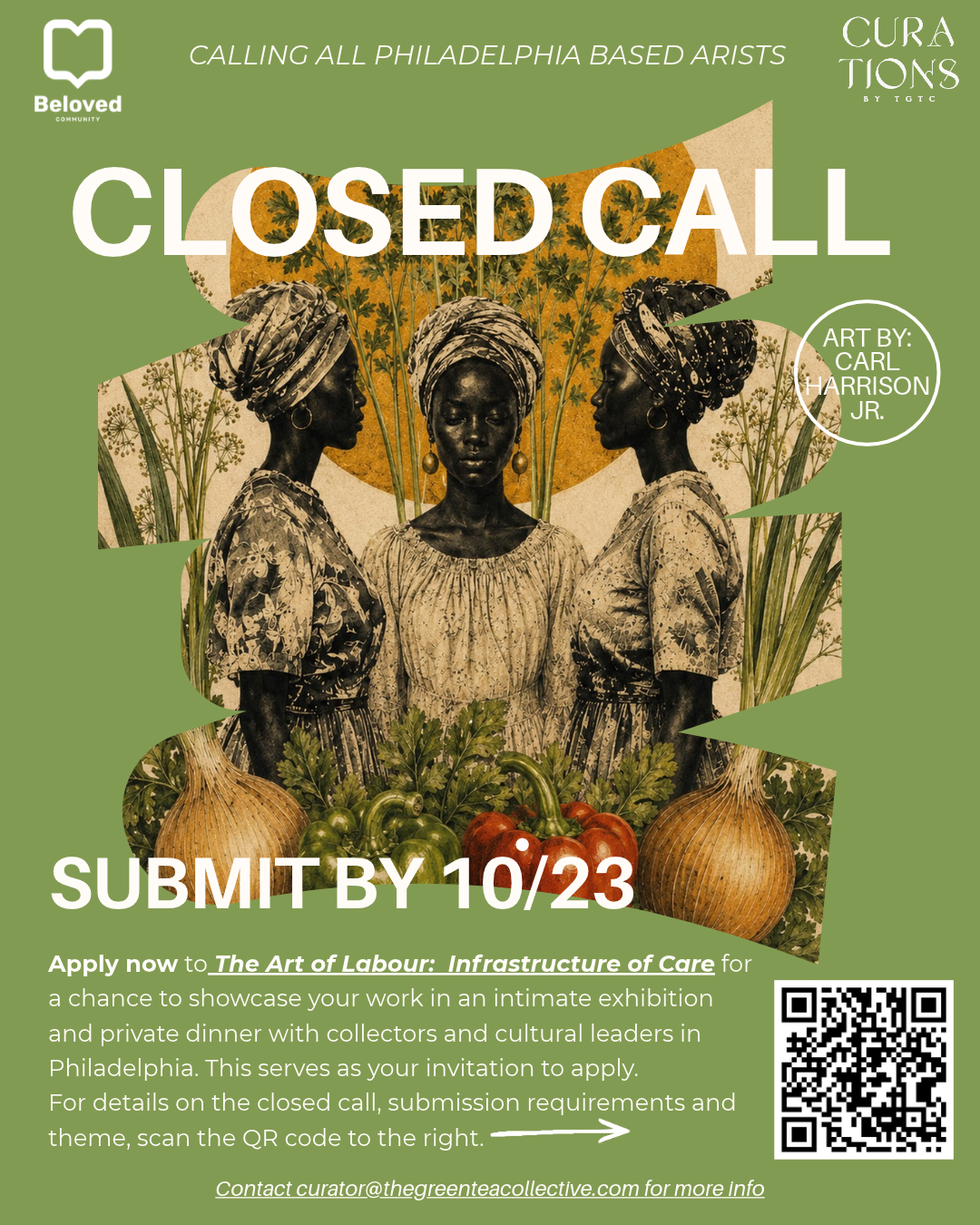
The Infrastructure of Care
Curated by Dr. Brooke E. Wyatt | Curations by TGTC
For the 2026 Philadelphia edition, The Art of Labour: The Infrastructure of Care, the series explores the ways that labour remains invisible within traditional economic systems. As the final selection in this series, Beloved elevates submissions that directly address: Community Engagement & Participatory Practice; Unconventional Work & Non-Traditional Media; and/or Social and Economic Justice.
Philadelphia
Philadelphia is a city forged by hands often left unacknowledged in historical archives. From its historic textile mills and industrial corridors to the rowhouses where generations of mothers, grandmothers, and early educators raise the city’s youth, labor has always been the heartbeat of our communities. Yet, the most vital labor—the work of care, early learning, language translation, and community stewardship—remains largely invisible within traditional economic systems.
The Art of Labour: The Infrastructure of Care invites artists across Greater Philadelphia to explore work not as mere transactional employment, but as an act of community building, survival, and social justice. Rooted in Beloved Community’s core value—Create with Abundance—this exhibition asks:
What does it look like to value care as civic infrastructure? How do invisible, unconventional, and intergenerational forms of labor shape the social fabric of our neighborhoods?
Drawing inspiration from community-engaged research centering Latine and working-class families navigating early education, language justice, and economic self-determination, this iteration of The Art of Labour serves as both a physical exhibition and a living dialogue.
Key Curatorial Pillars
We are seeking submissions that directly address one or more of the following core themes:
Community Engagement & Participatory Practice: Works rooted in deep neighborhood relationships, collective memory, oral histories, social practice, or direct collaboration with local caregivers, educators, and community members.
Unconventional Work & Non-Traditional Media: We encourage artists working outside traditional gallery boundaries—including fiber and textile arts, site-specific installations, recycled/found industrial materials, soundscapes, performance art, culinary heritage, or participatory toolkits. We champion artworks that reflect unconventional forms of labor itself.
Social & Economic Justice: Works that confront systemic barriers in childcare, language access, immigrant rights, spatial justice, and fair wage equity, while imagining abundant, liberated futures for working families.
Guiding Questions for Applicants
How does your creative practice highlight or honor invisible, domestic, or informal labor?
How do language access, cultural heritage, and community care function as tools of social transformation in your work?
In what ways does your art resist scarcity narratives and model collective abundance?